Bridging the Past
and the Present
The Heritage Museum stands inside the beautiful, historic grounds of the Lekham Walauwwa estate, a structure whose own roots date back 360 years. In these quiet corridors, we have gathered the archaeological records, vintage instruments, and archival documents that preserve the true identity of Ceylon’s legendary spice routes.
As Sri Lanka's first dedicated spice archive, the museum acts as a bridge. It connects the centuries-old traditional wisdom of rural farming systems with the global pathways of early maritime explorers, offering a clean, unhurried space for discovery.
View Archival Timeline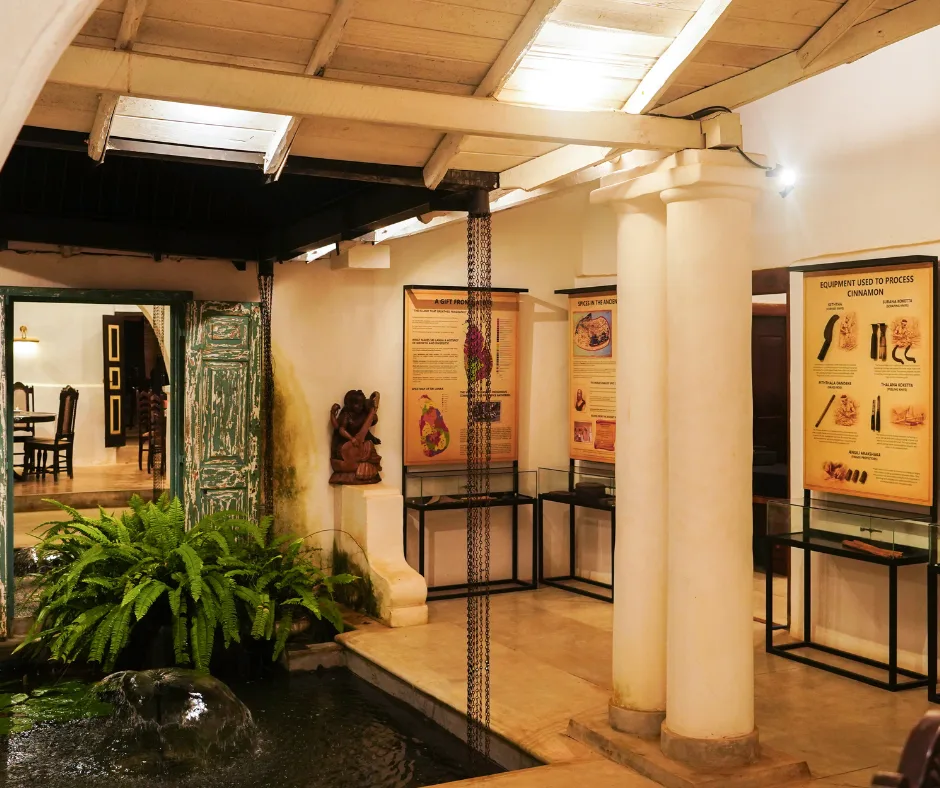
The Spice Routes
Long before Sri Lanka appeared on European maps, it was known as Taprobane to the Greeks and Romans and Serendib to Arab traders, the island became renowned for its precious cinnamon, pepper, and cardamom. These treasured spices travelled westward along the great maritime trade routes that connected Rome, Arabia, India, and China, earning the island a lasting place in the history of global trade.
As the centuries turned, maritime trade grew and Arab and Persian merchants mastered the seasonal monsoon winds and came to dominate the spice trade routes. Establishing thriving trading communities in ports such as Trincomalee, Beruwala, Galle, and Mantai, they controlled the cinnamon trade.
A storm carried a Portuguese fleet, led by Dom Lourenço de Almeida, to the shores of Galle, forever changing the island's history. Drawn by the island's valuable cinnamon trade, the Portuguese quickly shifted from trade to territorial control. Fortresses rose along the coast at Colombo, Galle, and Mannar, securing their hold over one of the most valuable commodities of the age.
Cardamom started to become a real export. Cardamom wasn't originally from Sri Lanka. It likely came over from South India, brought by Muslim traders who'd settled on the island. Either way, by 1524 it had a solid place in the international spice market.
While the coasts fell under Portuguese control, the Kandyan kingdom stood apart as an independent monarchy of Sri Lanka. Seeking to get rid of the Portuguese, the Kings of Kandy signed a treaty with the Dutch East India Company in exchange for control of the coastal cinnamon trade.
The Dutch captured Colombo in 1656 and, by 1658, had driven the Portuguese entirely from the island. Yet victory brought a new reality. Rather than honoring their agreement with Kandy, the Dutch established their own monopoly over the coastal cinnamon trade, replacing one colonial power with another.
Under Dutch rule, cinnamon harvesting got a lot more organized. Peelers had quotas, and every bundle was carefully graded and exported under the VOC seal before it shipped out. Pepper exports picked up around this time too, since demand in Europe kept growing. For nearly 140 years, Ceylon cinnamon became one of the Dutch East India Company's most profitable commodities.
During the Napoleonic Wars, the British captured Sri Lanka from the Dutch, inheriting the island's coastal cinnamon trade. They continued the established system while the global spice trade gradually became more competitive.
With the fall of the Kingdom of Kandy, the British gained control of the entire island, including all major cinnamon-growing regions. For the first time, Sri Lanka was administered under a single colonial government.
After nearly two centuries of government-controlled cinnamon trade under successive colonial powers, the British ended the state monopoly and opened the industry to private merchants. Cinnamon was no longer an imperial monopoly, it became a commercial crop grown and traded in a competitive market.
By the middle of the 19th century, the global spice trade was changing. A cheaper substitute; cassia cinnamon began flooding international markets, reducing demand for true Ceylon Cinnamon. At the same time, British planters shifted their investment to more profitable plantation crops such as coffee, cocoa, tea, rubber, and coconut. Cinnamon, once the island's most valuable export and the reason empires had fought for control of Sri Lanka, gradually lost its dominance in the colonial economy.
The Government of Sri Lanka established the Department of Minor Export Crops to promote cinnamon and other minor export crops. The initiative marked the beginning of a revival, encouraging cultivation, improving production practices, supporting growers, and helping Sri Lankan cinnamon regain its place in international markets.
Ceylon Cinnamon received Protected Geographical Indication (PGI) status from the European Union. Sri Lanka's first-ever GI certification legally recognized that true Ceylon Cinnamon could only come from its place of origin, safeguarding both its authenticity and the livelihoods of thousands of producers.
Sri Lanka still exports basically the same lineup the ancient world was buying: true cinnamon, black pepper, cardamom, cloves, and nutmeg, mostly grown around Matale, Kandy, Kegalle, Kurunegala, and Ratnapura.
No entries in this period.
Artifacts
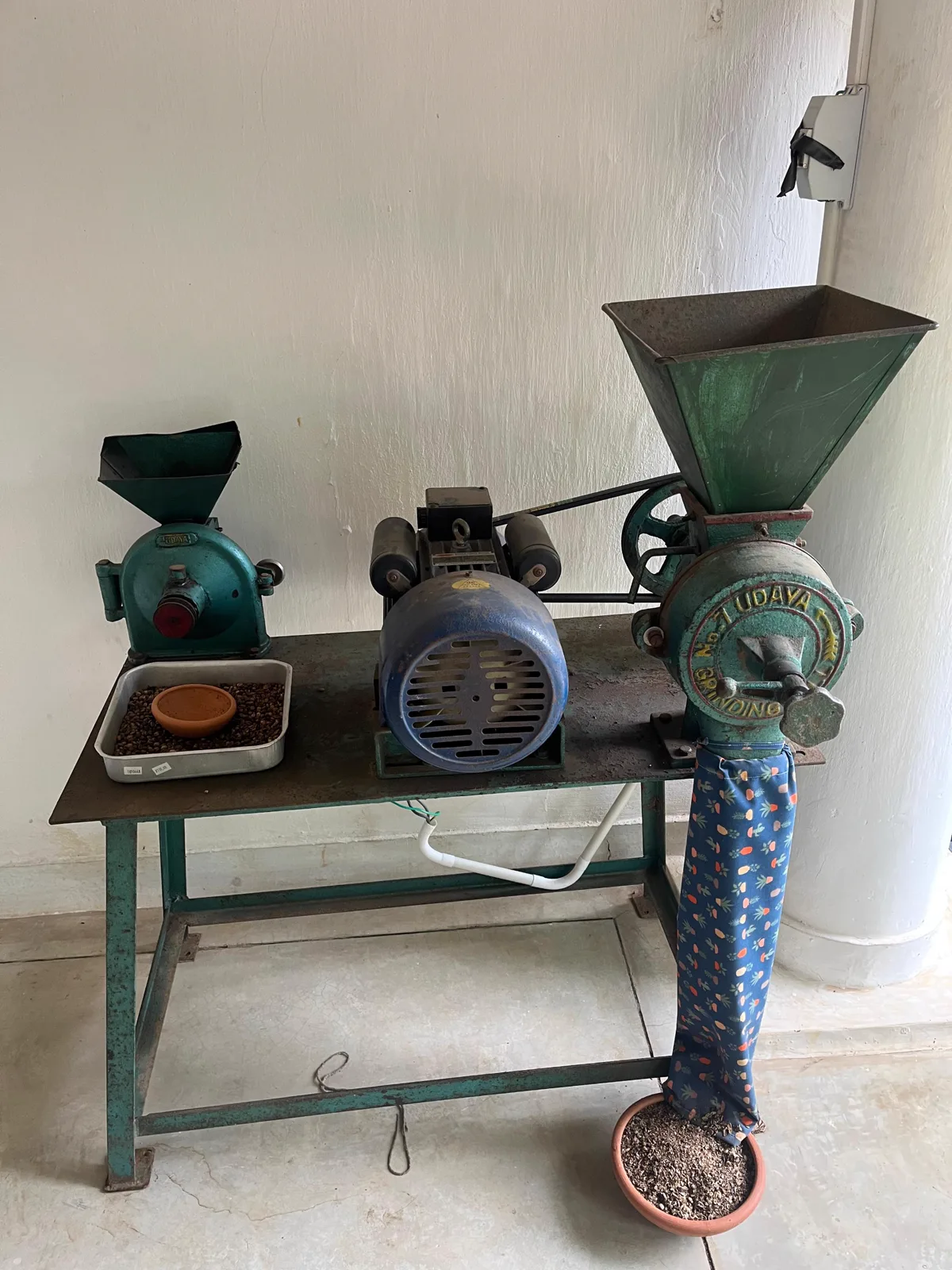
The Multi-Purpose Grinder - Udaya Industries
By the early 1970s, Sri Lanka had begun manufacturing many of the agricultural machines that were once imported. Companies such as Udaya Industries, based in the Kandy region, produced equipment designed to suit local crops and the needs of Sri Lankan farmers and spice processors.
This Udaya No. 07 Grinding Machine is one of those locally made innovations. Dried chillies, pepper, coriander, coffee beans, grains, and other ingredients were fed through the hopper at the top before being ground inside the cast-iron chamber.
Alongside the main grinder is a smaller grinding unit, used to crush larger or harder materials before they entered the main chamber. This made the grinding process smoother and more efficient.
Once ground, the finished product travelled through a fabric chute and was collected in a clay bowl below, ready to be packed or used. Simple, reliable, and built for everyday work, machines like this played an important role in supporting Sri Lanka's growing spice and agricultural industries.
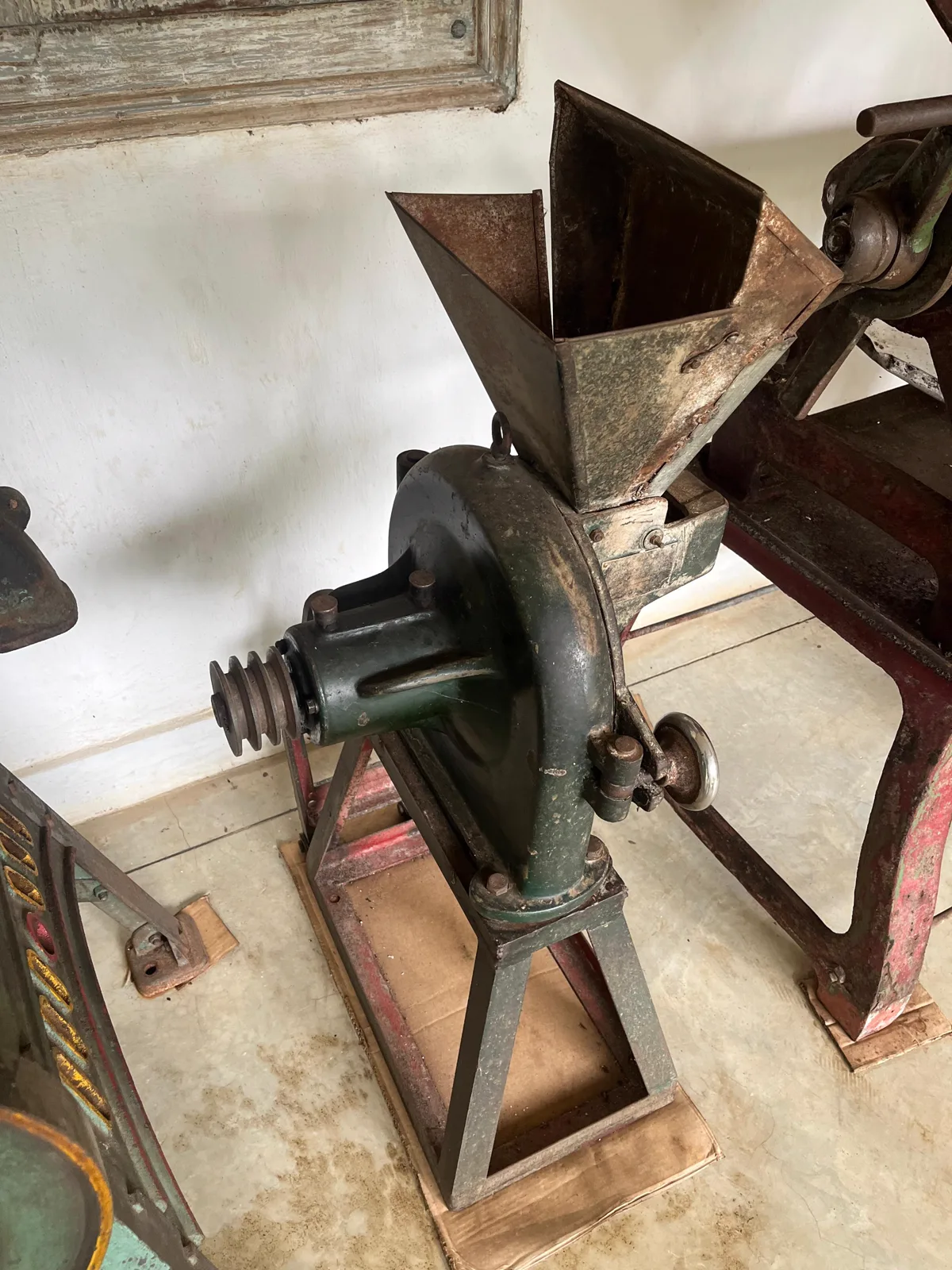
Grist Mill
This grist mill, commonly known as an ‘atta chakki’, reminds us of the early days of Sri Lanka when grinding grain and spices was an important part of everyday life. The name chakki comes from the Sanskrit word chakra, meaning “wheel,” inspired by the traditional stone grinding wheels that were used for generations before iron mills like this became common.
Grain or dried spices were poured into the metal hopper at the top, where they travelled down into the cast-iron grinding chamber. Inside, a pair of grinding plates worked together to crush the contents into flour or fine powder. The mill itself was powered by a belt connected to an external engine or, later, an electric motor, while a small handwheel allowed the miller to adjust the texture, from coarse grain to finely ground spice.
In a region like Matale, where farming and spice cultivation have long been part of daily life, a machine like this served many purposes. It could grind rice and millet into flour or turn dried pepper, chilli, and other spices into the powders that filled kitchens with familiar aromas.